Maker Dost — STEM Programs 2026

Where Curiosity Meets
The Future of Making

We don't just teach technology — we ignite a passion for creation. Join programs that transform curious minds into confident innovators through real robots, real code, and real impact.

0+
Students Trained
0+
Projects Built
0+
Sessions Done
Scroll
Robotics Engineering
Artificial Intelligence
Arduino & Electronics
Python Programming
Internet of Things
Computer Vision
Design Thinking
Innovation Lab
Robotics Engineering
Artificial Intelligence
Arduino & Electronics
Python Programming
Internet of Things
Computer Vision
Design Thinking
Innovation Lab
Choose Your Path

Every Learner Has a
Perfect Starting Point

Every program is built around one idea — that the best way to understand how AI thinks is to build something that thinks. From your first circuit to your first neural network, the journey starts here.

Step 01

School Programs

Build robots that sense, decide, and act — and discover that this is exactly how AI systems work in the real world. Electronics becomes the body. Code becomes the brain.

Ages 10 – 16
Step 02

Robotics Workshops

When a robot avoids an obstacle, it's making a decision — just like an AI agent would. Students learn to think like engineers and like machines, simultaneously.

Ages 12 – 18
Step 03

AI Sessions

Move from "what is AI?" to "I built an AI" in four weeks. Students train real models, understand how machines learn, and build tools that solve problems they actually care about.

Ages 14 – 18
Step 04

Maker Bootcamps

Five days of building systems that sense the world, process data, and respond intelligently. IoT meets AI thinking — students build the future, not just projects.

Ages 12 – 18
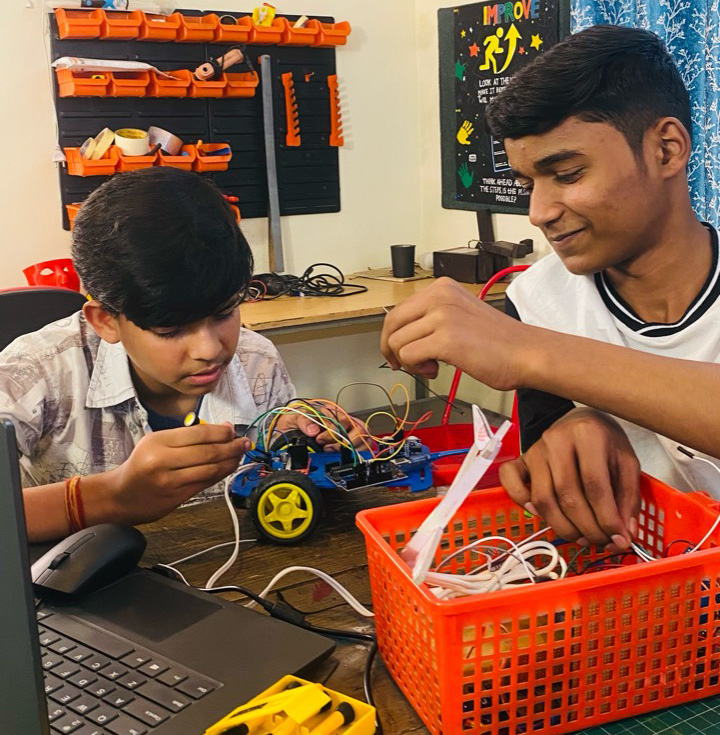
Students building robots at Maker Dost lab
100% Hands-on Learning
4.9/5 Student Rating
Why Maker Dost?

We Teach AI the Way
It Was Meant to Be Learned

AI isn't just a subject — it's a way of thinking. At Maker Dost, every project is designed to build that thinking from the ground up. Students don't just learn what AI is — they develop the mindset to create it.

Every Project Has an AI Thinking Layer

Even when students build a basic sensor circuit, we connect it to how AI systems perceive the world — turning hardware into a gateway to computational thinking.

From Sensing to Deciding to Acting

This is how every AI system works — and it's how every Maker Dost project is structured. Students internalise the AI pipeline without ever feeling overwhelmed by it.

Computational Thinking Built Into Every Class

Decompose. Find patterns. Abstract. Build the algorithm. These four steps are embedded into every session — so students think like engineers before they know it.

The Confidence to Build Intelligent Systems

By the end of any Maker Dost program, students don't just understand AI — they have built systems that demonstrate it. That confidence is the real outcome.

Detailed Programs

Every Project. Every Session.
Built Around AI Thinking.

We don't save AI for the last week. From the very first session, students are thinking the way intelligent systems think — sensing, processing, deciding, and acting.

01

School STEM Integration Program

A complete semester-long program where every robotics project is a hands-on lesson in how AI systems are built. Students discover that a robot sensing its environment and making decisions is the most honest introduction to artificial intelligence there is.

6 Months 24 Classes AI Thinking Integrated
Age Group
10–18 yrs
Duration
6 Months
Sessions
24 Classes
Level
Beginner+
AI Thinking Framework — Embedded Into Every Session

Students don't just build projects — they learn to think the way intelligent systems think. Every class follows this four-step computational thinking model.

01
Sense
What data does the system need? Sensors are how robots — and AI — perceive the world around them.
02
Process
How does the system understand that data? This is where code becomes the brain of any intelligent system.
03
Decide
What should happen next? Decision logic in code mirrors how AI agents choose actions based on conditions.
04
Act
The system responds to the world. Motors, LEDs, buzzers — physical outputs that make thinking visible and real.
Flagship Robotics & Intelligent Systems Projects
Smart Traffic Management System
Students design a multi-direction traffic control system that dynamically adjusts signal timing using real-time vehicle density input.

Core Learning: Sequential logic, timing algorithms, system automation.
Autonomous Line-Tracking Rover
A self-driving rover that follows a predefined path using IR sensor feedback, introducing students to real-world navigation principles.

Core Learning: Sensor feedback loops, proportional control, autonomous behaviour.
Obstacle-Aware Navigation Robot
A rover that detects obstacles using ultrasonic sensing and intelligently changes direction without human intervention.

Core Learning: Autonomous decision-making, reactive AI agents, spatial sensing.
Solar Energy Tracking System
A smart solar panel prototype that aligns itself toward the highest light intensity using LDR sensors and servo-based control.

Core Learning: Analog sensing, optimisation logic, renewable energy systems.
Wireless Competitive Rover Challenge
Teams build and program Bluetooth-enabled rovers for real-time competition challenges and tactical missions.

Core Learning: Wireless communication, real-time control, teamwork under pressure.
Intelligent Agriculture Monitoring System
A smart farming prototype that monitors soil moisture, temperature, and environmental conditions to automate irrigation decisions.

Core Learning: IoT sensing, environmental data analysis, decision-based automation.
Smart Surveillance & Intrusion Detection System
A multi-sensor security prototype combining motion, vibration, and environmental detection for real-time alert systems.

Core Learning: Sensor fusion, event detection logic, system reliability engineering.
Innovation Capstone — Intelligent System Design
Students identify a real-world problem and build a complete intelligent system integrating sensors, automation logic, and control mechanisms.

Core Learning: End-to-end engineering design, computational thinking, system architecture.

Skills Students Gain

  • Arduino programming and electronics fundamentals
  • Sensor integration and real-world data collection
  • Computational thinking — decompose, pattern, abstract, algorithm
  • Understanding how AI systems perceive and respond
  • Logic design and decision-making in code
  • Teamwork, iteration, and project thinking

What's Included

  • All electronics components and kits provided
  • Dedicated Maker Dost instructor per batch
  • AI thinking workbook alongside project guides
  • Certificate of completion for every student
  • Progress reports connecting skills to AI readiness
  • End-of-program innovation showcase event
Starting From ₹59,999
Limited school slots
02

Autonomous Robotics & AI Weekend Bootcamp

A 2–3 day immersive experience where students build intelligent robotic systems and train real AI models. From autonomous navigation to computer vision, this workshop blends hardware engineering with artificial intelligence.

3 Days 9 Hours Robotics + AI
Age Group
10–18 yrs
Duration
3 Days
Hours
9 Hours
Focus
Autonomous Systems
The Robot Is Your First AI — Here Is How We Think About It

Every robot project in this workshop is structured around the same loop that powers every AI agent in the world. Students build the hardware — and internalise the logic.

01
Perceive
Sensors give the robot awareness of its environment. This is how all AI systems begin: with data.
02
Reason
The microcontroller applies logic to sensor data. AI does this at massive scale.
03
Act
Motors turn, buzzers sound, LEDs light up. The system responds — just like an AI agent.
04
Improve
Students debug, tune, and iterate. This is exactly how AI models are trained.
Bootcamp Projects — Robotics Meets Artificial Intelligence
Autonomous Obstacle Navigation Module
Build a robot that detects obstacles using ultrasonic sensing and navigates independently without human control.

Learning Focus: Reactive intelligence, sensor feedback loops, decision logic.
Maker Dost Bot (Signature Project)
Design and assemble the official Maker Dost Bot — a multi-sensor intelligent rover capable of navigation, alert signaling, and autonomous behavior.

Learning Focus: System integration, modular robotics architecture, multi-sensor coordination.
Intelligent Line Tracking Rover
Develop a precision-controlled rover that follows a defined path using IR sensor feedback and speed tuning.

Learning Focus: Feedback control systems, proportional logic, autonomous vehicle concepts.
AI Gesture Control System
Train a computer vision model to recognize hand gestures and map them to real-time digital actions.

Learning Focus: Image-based AI, model training, real-time inference.
AI Object Classification Challenge
Create and train a custom AI model that identifies objects using live camera input.

Learning Focus: Supervised learning, dataset creation, model accuracy.
AI Emotion Detection Demo
Explore human-centered AI by analyzing facial expressions and understanding how emotion recognition models work.

Learning Focus: Pre-trained models, inference systems, AI ethics.

What Students Will Learn

  • Motor driver and sensor integration
  • Autonomous decision-making logic
  • Feedback control systems
  • Computer vision fundamentals
  • Machine learning model training basics
  • Connecting robotics with AI concepts

Final Bootcamp Experience

  • Live autonomous navigation challenge
  • AI model testing demonstration
  • Team collaboration and competition
  • Certificate of Completion
Workshop Fee ₹5,999
Limited seats available
03

AI & Intelligent Systems Bootcamp

This is not a demo-based AI course. Students learn how to design, evaluate, and build intelligent systems that sense data, analyze patterns, make decisions, and respond responsibly in the real world.

4 Weeks 22 Hours System-Level AI Thinking
Age Group
14–18 yrs
Duration
4 Weeks
Tools
Python + ML Libraries
Focus
AI System Design
Computational Thinking for AI — How Every Session Is Built

Every AI system is built using a structured engineering process. Students learn to think like system designers — not just model trainers.

01
Define
Clearly define the real-world problem before writing any code.
02
Design Data
Identify what data is required and analyze bias or limitations.
03
Build Model
Train, test, and evaluate system performance carefully.
04
Evaluate & Improve
Analyze failures, refine decisions, and assess ethical impact.
Build Intelligent Systems — Progressive AI Projects
Pattern Intelligence Lab
Train models to recognize custom patterns and compare accuracy across different datasets.
Bias & Decision Simulation Lab
Create intentionally biased datasets to observe how AI systems produce unfair or unreliable decisions.
Predictive Analytics Prototype
Build a structured-data prediction model and explore feature selection, uncertainty, and real-world limits.
Vision-Based Intelligent Monitor
Develop a perception-based AI system that detects environmental patterns and triggers responses.
Conversational Intelligence System
Design an intent-based AI assistant and evaluate system boundaries and failure cases.
Intelligent System Capstone
Design and present a complete AI-powered solution — from problem definition to deployment logic.

What Students Will Master

  • Designing AI systems from data to decision
  • Evaluating model accuracy and bias
  • Understanding supervised learning deeply
  • Connecting AI to real-world automation
  • Analyzing AI failures responsibly
  • Building intelligent systems independently

Bootcamp Outcome

  • Portfolio-ready AI projects
  • Live intelligent system demonstration
  • Technical presentation & peer review
  • Certification of AI System Design
Bootcamp Fee ₹14,999
Limited seats available
04

Elite Intelligence Lab

A 5-day flagship experience where students build machines that evolve from mechanical systems into autonomous intelligent entities. This lab trains system architects — not hobbyists.

5 Days 22 Hours Elite System Design
Age Group
12–18 yrs
Duration
5 Days
Focus
System Architecture
Outcome
Autonomous Intelligence
Intelligence Architecture — How Elite Systems Are Built

Every intelligent system is layered. Students build and understand each layer before integrating them into a unified architecture.

01
Mechanical Layer
Design stable actuation and movement systems under constraint.
02
Reactive Layer
Implement deterministic reflex logic and state machines.
03
Perceptive Layer
Integrate sensing and AI-based perception modules.
04
Adaptive Layer
Map perception to decision-making with fail-safe logic.
From Mechanism to Autonomous Intelligence
Day 1 — Mechanical Core Platform
Construct and calibrate a high-stability rover platform. Analyze torque, speed trade-offs, and system balance.
Day 2 — Reactive Intelligence Module
Integrate ultrasonic perception and deterministic reflex logic. Design escape strategies and analyze failure conditions.
Day 3 — AI Perception Integration
Train and deploy a controlled AI vision model. Evaluate bias, lighting sensitivity, and reliability.
Day 4 — Adaptive Decision Engine
Connect perception to action. Implement fallback protocols and fail-safe architecture.
Day 5 — Intelligence Arena
Live evaluation under variable conditions. Teams demonstrate autonomous performance in a dynamic arena.

Elite Learning Outcomes

  • Architect multi-layer intelligent systems
  • Design deterministic and adaptive control pipelines
  • Analyze system latency, reliability, and failure modes
  • Integrate AI perception with physical robotics
  • Evaluate bias and environmental variability
  • Present system architecture with technical precision

Signature Experience

  • Live "Intelligence Arena" showcase
  • Architecture mapping & explanation session
  • Failure analysis & improvement cycle
  • Elite Intelligence Lab Certification
Lab Fee ₹15,999
Limited elite seats available
THINK
Learning Outcomes

What Students Actually
Walk Away With

Not just skills — a completely new way of thinking. Every Maker Dost student leaves with the ability to look at any problem and see it the way an AI engineer would.

01

Systems Architecture Competency

Students design multi-layer intelligent systems integrating perception, decision logic, and actuation. They develop architectural thinking beyond coding tasks.

02

Algorithmic & Data Evaluation Skills

Students evaluate system reliability, model bias, and failure modes under variable environmental conditions — learning structured analysis of intelligent systems.

03

Applied AI & Embedded Integration

Students connect AI inference systems to real-world robotics, demonstrating end-to-end perception-to-action pipelines.

04

Technical Communication & Reflection

Students present system architecture, design trade-offs, and ethical considerations with clarity and professional structure.

Our Impact

Numbers That Tell
A Bigger Story

Behind every statistic is a student who discovered what they're capable of.

524+
Young Innovators Trained
30+
Real Projects Created
45+
Sessions Conducted

"Every student who builds their first robot, writes their first program, or solves their first real problem — that is the moment transformation happens. We don't just teach; we give students the confidence to believe they can shape the future."

The Maker Dost Team, New Delhi

For Schools & Institutions

Ready to Bring the
Maker Revolution
to Your School?

Partner with Maker Dost to transform how your students experience learning. We handle everything — curriculum, equipment, instructors, and outcomes. You get a generation of creators.

School Integration
Seamlessly woven into your existing timetable — zero disruption, maximum impact.
Custom Curriculum
Designed around your students' age, level, and goals — not a one-size-fits-all solution.
Ongoing Support
We don't disappear after Day 1. Full support throughout the program and beyond.